
In this article
What does a home battery do?
Solar panels generate electricity mostly during the day, while many households use most of their electricity in the morning and the evening. Without storage the surplus flows to the grid. A home battery captures part of that surplus so you can use it yourself later.
Without a home battery
During the day you use part of your solar power directly. What you are not using at that moment flows to the grid. In the evening you take electricity from the grid.
- Solar power
- Electricity from the grid
With a home battery
The surplus is stored in the battery first. Later, in the evening for example, you use that electricity yourself. Once the battery is full, the remaining surplus goes to the grid.
- Solar power
- From the battery
- Electricity from the grid
Smart energy management
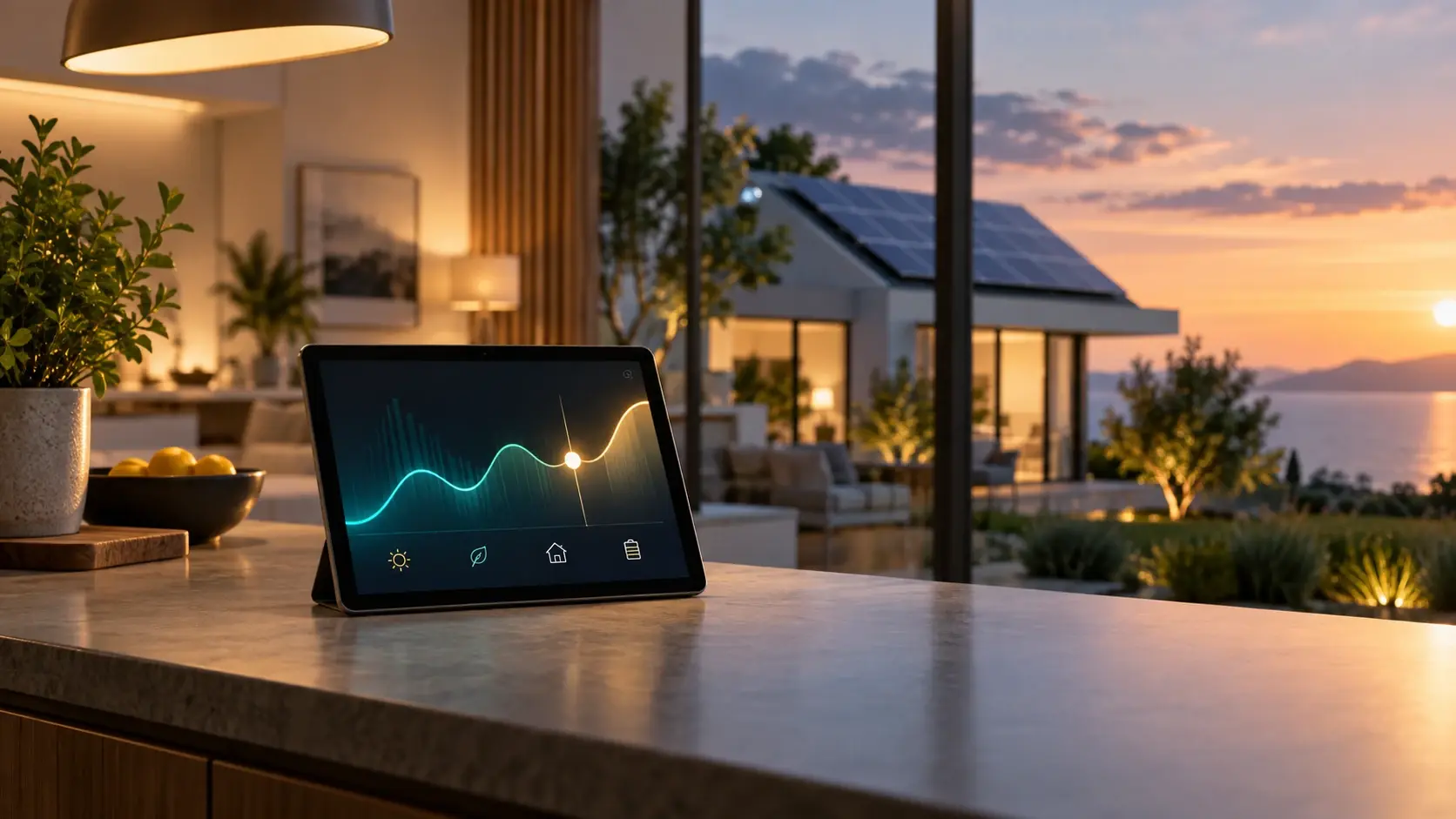
The system takes your generation, your consumption, the state of the battery and — where available — energy prices into account. That is how it decides when the battery charges, discharges or exports.
- Solar power
- From the battery
- Electricity from the grid
- Smart control
An illustrative example. How much solar power you use directly, store or export differs per home and depends on your consumption, your solar panels and the battery capacity, among other things.
What does a home battery system consist of?
A home battery system usually consists of a few parts that work together:
Battery module(s)
This is where the electricity is stored.
Inverter
Converts direct current into alternating current for your home, and the other way round when charging.
Energy management
Software that decides when the battery charges and discharges.
Connection
The link with your meter cupboard and electrical installation.
Which parts you need depends on your existing installation, such as your solar panels and inverter.
What does smart energy management do?
Smart energy management weighs up several signals: how much electricity your panels are generating, what your home is using at that moment, how full the battery is and — on a dynamic energy contract — what electricity costs right now. On that basis the system decides when the battery charges, discharges or exports. What is possible differs per system and configuration.
When might a home battery suit your situation?
A home battery can suit your situation functionally if one or more of these apply:
- you export a lot of solar power during the day and use electricity later on;
- you want to use more of your own solar power within the same day;
- your energy contract gives price signals a battery can respond to intelligently;
- you have access to flexibility or trading services that work with your system;
- you are looking for a specific function, such as backup power, and the system you choose genuinely supports it.
A home battery is not financially attractive for every home, and a bigger battery is not automatically better. Milieu Centraal notes that at current costs a home battery does not pay for itself through savings on the electricity bill in many situations, and that producing the battery also has an environmental impact. Other uses, such as dynamic trading or flexibility services, can generate additional income, but these depend on market prices, contract conditions and control, and are not guaranteed. Good advice therefore starts with your consumption, your generation and your goal — not with a product.
What to look at when choosing
- Capacity and power: how many kWh can the battery store, and how many kW can it charge or deliver at once?
- Connection: do you have a single-phase or three-phase connection? Read what that means.
- Future plans: is an electric car or a heat pump coming?
- Installation and placement: where will the battery go and who installs it?
- Efficiency and warranty: look at charge and discharge losses, warranty conditions and any limits on cycles or remaining capacity.
- Backup power: a home battery does not automatically work during a power cut. That needs a system that explicitly supports a backup function.
- Service and control: check who manages the software, which contracts are needed, and what happens if you later want to switch supplier or service provider.
Frequently asked questions
How big should a home battery be?
That depends on your consumption, how much solar power you have left over, when you use electricity and your plans. A bigger battery is not automatically better, which is why we look at capacity per home.
Is a home battery worthwhile for everyone?
No. For some households a home battery fits well, for others less so. Your consumption pattern, generation, connection and energy contract together decide whether it makes sense.
Can I expand a home battery later?
That differs per system and configuration. Discuss your future plans — an electric car or a heat pump, for example — during the advice conversation.
Sources
For rules and policy we refer to official and independent sources.
- Milieu Centraal: Thuisbatterij: zonne-energie opslaan (opens in a new window)
- Milieu Centraal: Meer zonnestroom zelf verbruiken (opens in a new window)
Last checked on September 20, 2026. Rules and rates can change; this information is general and not personal advice.